
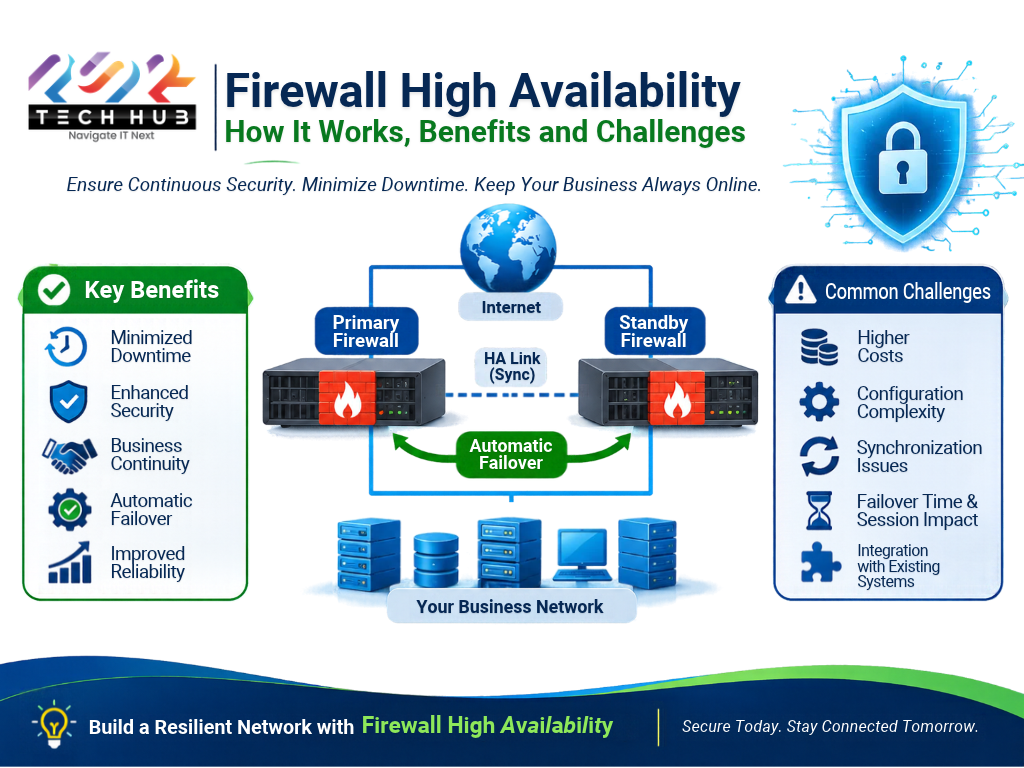
Introduction
In today’s digital business environment, network security and uninterrupted connectivity are essential for every organization. Businesses depend on secure networks to manage applications, store critical information, communicate with customers, and operate daily business activities. Even a few minutes of network downtime can result in financial losses, reduced productivity, and damage to business reputation.
A firewall plays a critical role in protecting an organization’s IT infrastructure against cyber threats, unauthorized access, malware, and network attacks. However, what happens when the firewall itself fails?
This is where Firewall High Availability (HA) becomes important. High Availability firewall solutions help organizations maintain continuous network security by deploying multiple firewalls that work together to minimize service interruptions and provide automatic failover during hardware or software failures.
In this blog, we explore what Firewall High Availability is, how it works, its key benefits, common challenges, and best practices for implementing an effective HA firewall architecture.
What Is Firewall High Availability (HA)?
Firewall High Availability (HA) is a network security architecture in which two or more firewall devices are configured to work together to ensure continuous network protection and connectivity.
In an HA setup, one firewall typically operates as the primary device, while another firewall remains available to take over if the active firewall experiences a failure.
When a problem occurs, the secondary firewall automatically assumes the responsibilities of the primary firewall, helping maintain network traffic flow and minimizing downtime.
The primary objective of Firewall HA is to eliminate a single point of failure in the network security infrastructure.
Organizations commonly implement HA firewall configurations in data centers, enterprise networks, cloud environments, and mission-critical IT infrastructures where uninterrupted connectivity is essential.
How Does Firewall High Availability Work?
A High Availability firewall setup generally consists of two firewall devices connected through dedicated HA links and configured to monitor each other’s health.
These devices exchange information such as configuration settings, connection states, and operational status to ensure synchronization.
When the active firewall experiences a failure, the standby firewall detects the issue and takes over the active role.
This process is known as Firewall Failover.
For example, if an organization’s primary firewall suddenly stops working due to hardware failure, the secondary firewall automatically becomes active and continues processing network traffic.
This helps reduce service disruption and ensures that security policies remain operational.
Types of Firewall High Availability Configurations
There are two commonly implemented HA configurations.
1. Active-Passive Configuration
In an Active-Passive HA configuration, one firewall operates as the active device and handles all network traffic, while the second firewall remains in standby mode.
If the primary firewall fails, the standby firewall automatically takes over its responsibilities.
Key Features:
- One active firewall processes network traffic.
- The secondary firewall remains in standby mode.
- Configuration synchronization keeps both devices consistent.
- Automatic failover occurs during primary firewall failure.
- Provides redundancy and business continuity.
Best suited for: Organizations that prioritize network reliability, security, and simplified firewall management.
2. Active-Active Configuration
In an Active-Active HA configuration, multiple firewall devices actively process network traffic simultaneously.
Traffic is distributed across the available firewall devices based on the platform’s supported load-balancing or clustering mechanism.
If one firewall becomes unavailable, the remaining device or devices can continue processing traffic, subject to available capacity.
Key Features:
- Multiple firewalls actively process traffic.
- Supports traffic distribution and load sharing.
- Improves resource utilization.
- Provides redundancy and failover capabilities.
- Can support higher network traffic demands.
Best suited for: Large enterprises, data centers, and organizations with high network traffic volumes.
Key Benefits of Firewalls on High Availability
Implementing Firewall HA provides several advantages for organizations looking to strengthen their network security and infrastructure reliability.
1. Minimized Network Downtime
One of the biggest advantages of Firewall HA is reduced network downtime. If the primary firewall experiences a hardware or software failure, the secondary firewall can automatically take over.
This helps organizations maintain network connectivity and reduces interruptions to critical business operations.
2. Improved Network Security
High Availability ensures that firewall protection remains available even when one firewall device fails.
Security policies, access control rules, and traffic inspection capabilities can continue operating through the available firewall, depending on configuration and synchronization.
3. Business Continuity
Businesses depend on uninterrupted access to applications, cloud services, databases, and communication platforms.
Firewall HA helps maintain essential network connectivity during unexpected failures, supporting business continuity and disaster recovery strategies.
4. Automatic Failover
Automatic failover eliminates the need for manual intervention during many common firewall failure scenarios.
When the primary firewall becomes unavailable, the secondary device can take over based on predefined health-monitoring and failover conditions.
This reduces recovery time and helps IT teams maintain operational efficiency.
5. Better Network Reliability
Deploying redundant firewall devices reduces the risk of a single device failure affecting the entire network.
This is particularly important for enterprises, government organizations, financial institutions, healthcare providers, and data centers.
6. Improved Resource Utilization
Active-Active firewall configurations can distribute network traffic across multiple devices.
This allows organizations to utilize available firewall resources more effectively while supporting growing network demands.
7. Scalability and Infrastructure Resilience
As businesses expand, their network infrastructure must support increasing users, applications, and data traffic.
A properly designed HA firewall architecture provides a foundation for scaling network security while improving overall infrastructure resilience.
Common Challenges of Firewall High Availability
Although Firewall HA offers significant advantages, implementing and managing a high-availability architecture also involves certain challenges.
1. Higher Infrastructure Costs
Deploying multiple firewall devices increases the initial investment in hardware, software licenses, support contracts, and associated infrastructure.
Organizations must evaluate their security requirements, budget, and expected business impact before selecting an HA solution.
2. Configuration Complexity
Configuring firewall HA requires careful planning of network interfaces, synchronization links, routing, security policies, and failover parameters.
Incorrect configurations may result in unexpected failovers, connectivity problems, or security gaps.
3. Configuration Synchronization Issues
Both firewall devices must maintain consistent configurations to ensure seamless operation.
Synchronization problems involving firewall policies, routing information, or connection states can affect failover performance.
Regular monitoring and configuration validation are important to avoid these issues.
4. Failover Time and Session Disruption
Although HA minimizes downtime, failover does not always guarantee zero interruption.
Depending on the firewall platform, configuration, and session synchronization capabilities, existing connections may experience brief disruptions or require reconnection.
Organizations should understand the expected failover behavior before deployment.
5. Compatibility and Integration
Firewall HA solutions must integrate properly with the existing network infrastructure, including routers, switches, VPN connections, load balancers, and other security solutions.
Compatibility issues can create operational challenges and affect network performance.
6. Monitoring and Maintenance
High Availability environments require continuous monitoring of firewall health, synchronization status, resource utilization, and failover events.
Regular maintenance, firmware updates, and testing are necessary to ensure that both devices remain operational and ready for failover.
7. Single Points of Failure Beyond the Firewall
Deploying redundant firewalls alone does not eliminate every network failure risk.
Power supplies, network switches, cables, upstream internet connections, and HA synchronization links may still become single points of failure if they are not designed with redundancy.
Organizations must consider the entire network architecture when implementing HA.
Best Practices for Implementing Firewall HA
To achieve reliable and effective firewall high availability, organizations should follow these best practices:
1. Choose the Right HA Architecture: Select Active-Passive or Active-Active based on network traffic, business requirements, and availability objectives.
2. Ensure Configuration Synchronization: Verify that firewall policies, routing configurations, and supported session information remain synchronized.
3. Implement Redundant Connectivity: Use redundant network links, power supplies, and appropriate switching infrastructure to eliminate additional single points of failure.
4. Conduct Regular Failover Testing: Perform controlled failover tests to confirm that the secondary firewall takes over as expected.
5. Monitor Firewall Health: Continuously monitor device performance, CPU utilization, memory usage, interface status, and synchronization alerts.
6. Maintain Firmware and Security Updates: Keep firewall devices updated with vendor-recommended firmware and security patches, following a tested maintenance procedure.
7. Document the Network Architecture: Maintain clear documentation of firewall configurations, network topology, failover procedures, and recovery processes.
8. Define Availability Requirements: Establish Recovery Time Objectives (RTO) and Recovery Point Objectives (RPO), where applicable, and align the HA design with business continuity requirements.
Why Businesses Need High Availability Firewall Solutions
As cyber threats become increasingly sophisticated and businesses rely more heavily on digital infrastructure, maintaining uninterrupted network security is no longer optional.
Organizations operating enterprise applications, cloud platforms, data centers, and remote workforce environments need reliable security infrastructure that can withstand unexpected failures.
Firewall High Availability helps businesses:
- Reduce network service interruptions.
- Maintain continuous security enforcement.
- Protect critical business applications.
- Improve infrastructure reliability.
- Support uninterrupted business operations.
- Strengthen enterprise network resilience.
By investing in a well-designed HA firewall architecture, organizations can improve their security posture while building a more reliable IT environment.
Conclusion
Firewall High Availability is an essential component of modern enterprise network security. By deploying redundant firewall devices with automatic failover capabilities, organizations can minimize downtime, maintain security protection, and improve business continuity.
However, successful HA implementation requires more than simply installing two firewall devices. Proper architecture planning, configuration synchronization, redundant connectivity, continuous monitoring, and regular failover testing are critical to achieving the desired availability.
Businesses should work with experienced network security professionals to design and implement firewall HA solutions that align with their infrastructure requirements and business objectives.
Strengthen Your Network Security with PSR Tech Hub
At PSR Tech Hub, we understand the importance of building secure, reliable, and resilient IT infrastructure for modern businesses.
We help organizations strengthen their IT environments through enterprise network infrastructure, cybersecurity solutions, firewall deployment, configuration, and managed IT services.
Whether you are planning a new firewall implementation, upgrading your existing security infrastructure, or looking to implement a High Availability firewall architecture, having the right technology strategy and technical expertise makes a significant difference.
Looking to improve your network security and minimize downtime?
Connect with PSR Tech Hub to explore reliable firewall and enterprise network security solutions.
PSR Tech Hub – Empowering Businesses with Secure and Reliable IT Infrastructure.